The Leadership Ecosystem: Why Great Leaders Need More Than Training
8 September 2026 · Ayegbusi Temitope

People use the word "ecosystem" often, but they rarely stop to interrogate what it actually requires. An ecosystem is not simply a collection of things that happen to occupy the same space; it is defined by the relationships between those things and by what happens when one part of the system changes.
A forest illustrates this well. Trees, soil, water, insects and microorganisms all exist within the same environment, yet what makes a forest an ecosystem rather than a pile of biological matter is the way each part depends on, feeds, and constrains the others. Remove the insects, and the soil eventually loses its nutrients.
Poison the water, and the trees eventually die. Leadership behaves the same way, because a leader does not develop or fail in isolation; a leader develops or fails inside a web of conditions that either sustain them or slowly starve them.
Most conversations about leadership treat the problem as one of supply: find capable people, put them through the right training, and the pipeline will take care of the rest.
At Penthouse Leadership Institution, we do not think that assumption survives contact with reality. A person can receive excellent leadership training and still walk into an environment that punishes initiative. Someone can be taught strong ethical standards and then spend a decade inside a culture that rewards the opposite of everything they were taught.
A young leader can be thoroughly prepared for responsibility and still fail to find a structure willing to give them any responsibility to practise on. Training changes a person's capacity; it does not automatically change the conditions that person will be asked to operate within, and that gap is where a great deal of promising leadership quietly dies.
This is why we argue that leadership development has to be understood as an ecosystem rather than as an event.
For us, that ecosystem rests on four interlocking parts: the pipeline that develops people, the structure that absorbs them, the culture that shapes what they believe is normal, and the feedback loop that determines whether they eventually go on to develop someone else.
The uncomfortable insight is that a society, or an organisation, can possess all four of these elements and still produce a dysfunctional leadership ecosystem, because the problem is rarely that one part is entirely missing. More often, the four parts are simply not talking to each other.
1. The Pipeline: Where Leaders Are Developed

The pipeline is the part of the ecosystem where people are first identified, exposed to leadership, and intentionally developed before responsibility formally arrives. This includes schools, mentorship programmes, leadership academies, fellowships, professional communities, youth organisations, religious institutions, and any other environment where a person is allowed to practise judgment before that judgment carries real consequences.
The logic behind the pipeline is straightforward: a person should learn how to make a difficult decision before that decision affects hundreds of people, should learn how to sit inside disagreement before they are responsible for managing a team through it, and should develop ethical instincts long before power ever allows them to abandon those instincts quietly.
This matters with particular urgency in Nigeria because of the sheer scale of its demographic reality. According to the United Nations Population Fund, Nigeria's population reached approximately 237.5 million people in 2025, making it one of the largest and youngest populations anywhere in the world. A significant share of that population will, within a decade, become the workforce, the entrepreneurs, the professionals, the policymakers and the institutional leaders who determine the country's trajectory.
The relevant question, then, is not whether Nigeria possesses enough raw leadership potential; it clearly does. The question is whether the country is building enough deliberate pathways to convert that potential into developed judgment before circumstance forces it into positions of consequence anyway.
Organisations such as LEAP Africa already do meaningful work in youth leadership, entrepreneurship, employability and active citizenship, which means the pipeline is not empty.
But a pipeline can be full and still be poorly distributed, in much the same way that a country can have abundant rainfall concentrated entirely in one region while the rest experiences drought.
Young people are being extensively developed for technology, entrepreneurship and media, sectors that are comparatively open and visible, while remaining largely absent from the rooms where slower, less visible institutional decisions are actually made.
The result is an imbalance in which a generation becomes highly skilled at leading in the spaces that were already accessible, while remaining underprepared for the harder, more closed spaces that arguably need fresh leadership the most.
2. The Structure: Where Developed Leaders Actually Function
What happens to someone after they have been developed? A pipeline without a structure to receive its graduates is like constructing an elaborate network of roads that lead nowhere in particular.
This is why we believe leadership development can never be separated from institutional development. It is possible to teach someone to think strategically, communicate persuasively and solve problems creatively, and still watch that development wither if the system they enter does not reward competence, does not offer meaningful opportunity, and does not allow responsibility to be exercised in practice rather than merely discussed in theory.
Consider entrepreneurship as a case study in structural constraint. According to the World Bank, fewer than one in twenty Nigerian micro, small and medium enterprises currently have access to formal bank credit, even though these businesses account for the majority of enterprises in the country and contribute nearly half of its gross domestic product.
High borrowing costs, demanding collateral requirements and short loan tenures continue to shut out businesses that are otherwise entirely viable. That is not a motivation problem, and no amount of exhortation to "think big" will resolve it, because you cannot coach your way around a system in which productive capital is structurally inaccessible to the people who need it most.
The same principle governs leadership more broadly. When prepared people repeatedly encounter structures in which competence is not rewarded, most people will divert their energies into other things or other places. They will take their developed capacity to an environment willing to use it. The japa syndrome and the olodo economy are all a structure problem.
3. The Culture: What People Learn Is Normal
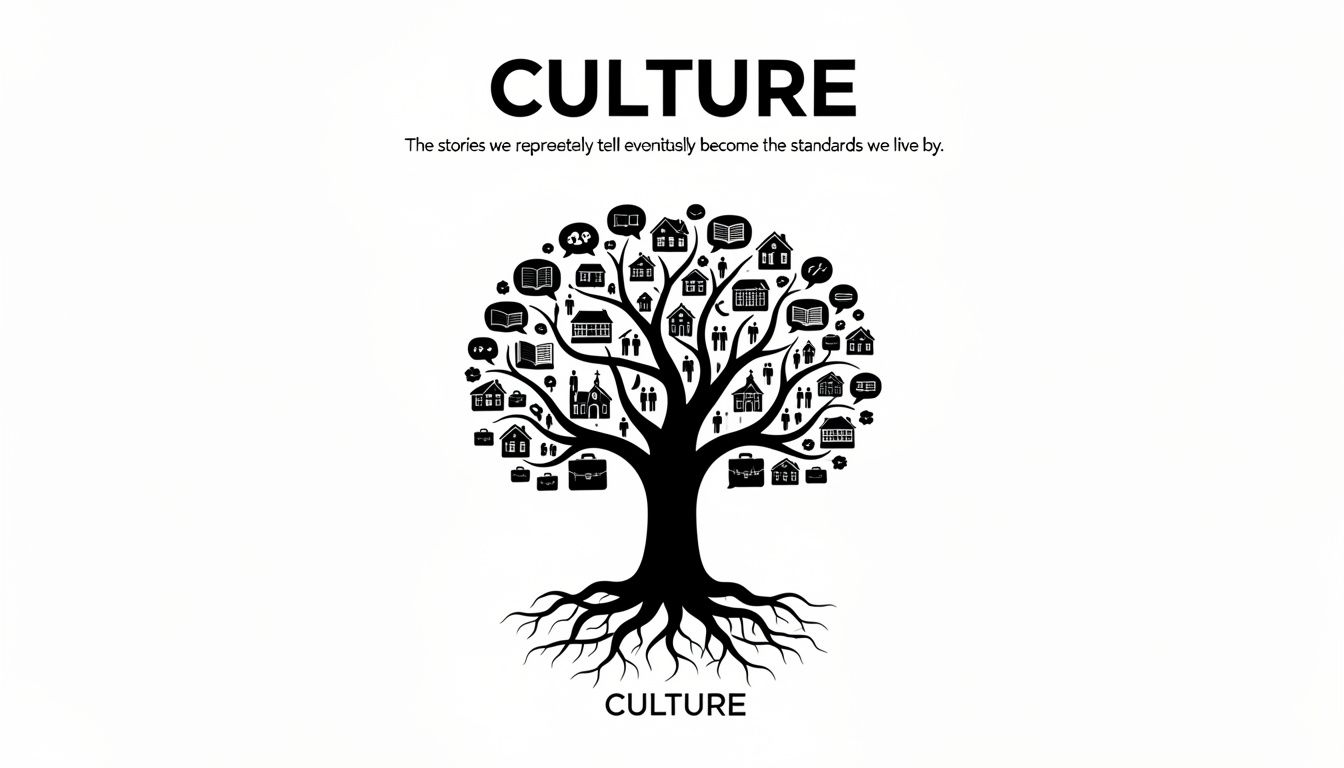
Culture is perhaps the most misunderstood component of the leadership ecosystem. We think of culture as a story that enough people quietly repeat, through action rather than instruction, until a wider audience comes to accept that story as the standard.
Nobody has to formally tell a new employee that meetings start twenty minutes late; they learn it the first week, simply by observing what everyone else treats as normal. Nobody circulates a memo declaring that senior colleagues should never be challenged; new hires absorb that rule by watching what happens to the one person who tries. Culture teaches without ever presenting itself as a lesson, and that is precisely what makes it so powerful, and occasionally so dangerous.
Culture can, of course, work in a constructive direction. A family can cultivate a culture of responsibility that outlives any single conversation about values. A community can build a culture of service that shapes behaviour long after the founders who modelled it are gone.
A company can establish a culture of excellence that new employees inherit before they fully understand why it matters, and a religious institution can sustain a culture of generosity and accountability across generations.
Nigeria of today has several stories that circulate even to new entrants. The idea that the system is corrupt, or that connection beats competence. We also have the good stories of resilience and pride in resources.
The deeper problem is that new entrants to a system absorb these stories without ever consciously choosing them.
This is why changing an organisation's or country's culture is far more difficult than delivering a speech about the importance of change. A speech alters a sentence that people hear once. Culture is a pattern that people live inside every day, and patterns do not yield to rhetoric; they yield only to a sustained, deliberate change in what the system consistently rewards and consistently tolerates.
4. The Feedback Loop: How Leadership Reproduces Itself
The final component of the ecosystem is the feedback loop, and it is the mechanism that determines whether the entire system is sustainable or merely episodic.
A person moves through the pipeline, enters a structure, contributes to its culture, and, if the loop functions correctly, eventually returns to develop someone else.
They become the mentor, the sponsor, the person who opens the door they once needed opened for them. This is how leadership compounds over time rather than resetting with every new intake.
Without a functioning feedback loop, leadership development becomes little more than a series of disconnected interventions. If the loop does function, the person who was once developed begins developing someone else in turn, and the cycle continues well beyond the reach of any single programme.
The Real Problem
We do not believe Nigeria's leadership challenge can be solved simply by launching more leadership programmes, useful as those programmes are, because a programme is only ever one part of a much larger system.
What the ecosystem actually requires is a pipeline capable of reaching beyond the sectors that are already comparatively open, a structure capable of absorbing the capable people that pipeline produces, a culture that makes responsible leadership feel normal rather than exceptional, and a feedback loop that allows good leadership to reproduce itself across generations rather than expiring with its first cohort.
Leaders do not exist independently of their environments; they are shaped, sustained or slowly worn down by them.
A young person can spend years internalising integrity and then enter a system that rewards dishonesty at every turn. They can learn to innovate and then join an institution that punishes the very experimentation it claims to want.
They can be taught responsibility and then land in an environment where accountability has quietly gone extinct.
At some point, the question we ask cannot remain limited to "how do we produce better leaders?" We believe the harder, more important question is: what kind of ecosystem are we producing them into? That question is more difficult to answer honestly, which is exactly why it tends to be avoided.
What This Means for Organisations

Book a quick call or speak to a representative
The Leadership Ecosystem framework is not confined to national conversations about governance and demography; it applies with equal force inside individual organisations.
A company can run an excellent leadership programme and still maintain a poor leadership ecosystem if it trains managers for six months and then grants them no real authority, teaches accountability while quietly rewarding excuses, preaches innovation while punishing the failures that innovation inevitably produces, or talks about people development while promoting only those who have simply been present the longest.
In that kind of environment, training becomes a ritual disconnected from how decisions are actually made, and everyone involved eventually learns to treat it as such.
The more useful question for any organisation to ask is not merely what kind of leader it is trying to produce, but whether the environment surrounding that leader is actually built to help them survive and grow once the training ends. That, in our experience, is where leadership development stops being a compliance exercise and starts becoming genuinely interesting. Talk to our team for practical leadership training and experiences.
Why We Built Penthouse Around This Idea

This thinking sits at the foundation of Penthouse Leadership Institution. We are committed to developing well-rounded leaders, but we also recognise, deliberately, that development does not conclude with theories alone. Our Leadership Academy works with individuals through practical learning, simulations, live projects and collaborative experience, while our Corporate Leadership Programmes help organisations think more intentionally about how they develop their employees and emerging team leads.
Our longer-term ambition is to contribute to healthier leadership ecosystems across Africa, which means thinking beyond training alone, toward people, structures, culture, opportunity, and what happens once a developed leader is ready to begin developing someone else.
The goal, ultimately, is not simply to produce more leaders. The goal is to build systems that keep producing them, long after any single cohort has moved on.